About
"Emergent Cooperative Gameplay" is the title of a 2008 Master's thesis written and developed by Liz England while attending the Guildhall program at Southern Methodist University.Download the Game

the Gamer's Dilemma
- Requires 2 Players
- Works Best with Controllers
Online Abstract
Full Master's Thesis


Contact
lizengland07[at]gmail.com
Part 1: Introduction
For this Master's thesis, 'emergent cooperative gameplay' is when players choose to cooperate in an otherwise non-cooperative game.The project had two goals:
- Can you make a game that subtly but reliably influences players to cooperate over time in an otherwise competitive environment?
- Can you do the above without sacrificing fun?
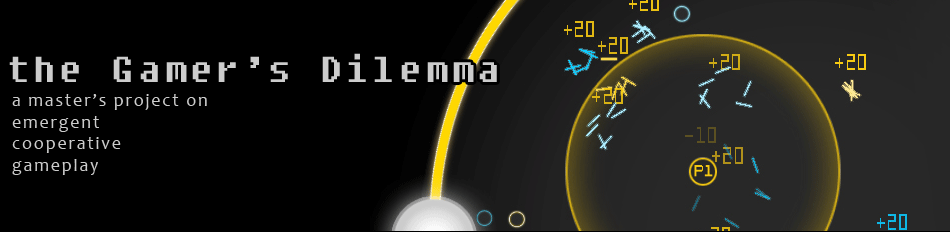
This Master's project is half game and half data. The Gamer's Dilemma is a 2D two-player game that implements a system derived from game theory in order to influence the choices players make.
Background
Most cooperative games beat players over the head with hard rules for
cooperation - players are put on teams and pit against other teams, they
share the same goals (i.e., defend the flag), and unilateral actions
costs you and your team points, while actions that help the team give
the individual extra points. These tactics work extremely well.
This project, though, is concerned with creating a system where there
are no explicit rules on cooperating with or competing against the other
players and then seeing if that system actually works - if, over time,
players choose to cooperate.
A system already exists that does this, though it's typically used in
mathematics, economic theory, political science, and even evolutionary
theory: the Prisoner's Dilemma. Players are given two choices -
cooperate with the other person or rat them out by defecting - and based
on the combined choices of two players a different outcome plays out.
When playing a single round of the Prisoner's Dilemma, humans will
defect (compete) against each other about 70% of the time, often to
their own detriment. But when playing multiple rounds of the Prisoner's
Dilemma - known as the Iterated Prisoner's Dilemma - player
strategies curve up towards cooperation over time.
The Prisoner's Dilemma is essentially a system that creates a naturally
occurring - or emergent - cooperative strategy.
Unfortunately, the Prisoner's Dilemma is normally only played in a very
sterile environment with none of the bells and whistles you see in a
game marketed for entertainment. The Prisoner's Dilemma is not fun. The
Iterated Prisoner's Dilemma is downright tedious.
The challenge, then, was to take the system of the Prisoner's Dilemma
and implement it in a video game, add dozens of variables (like flashy
graphics, timers, movement, and enemies!), make it fun, but still get
the underlying system to influence players to change their strategies to
cooperate with one another.
What the Project Does
For this project, I created a two-player 2D game called "The Gamer's Dilemma". In a series of fast rounds, players had two choices: send out a bomb to destroy the enemies converging upon them, or redeem that bomb for points to add to their score. Each player's objective was to get the highest possible score within sixty rounds.
While they play, the game records all kinds of data, such as they choice they make each round, their score, and their controls, and used that data to figure out if the project was a success and identify what new variables affected player choices the most.