About
"Emergent Cooperative Gameplay" is the title of a 2008 Master's thesis written and developed by Liz England while attending the Guildhall program at Southern Methodist University.Download the Game

the Gamer's Dilemma
- Requires 2 Players
- Works Best with Controllers
Online Abstract
Full Master's Thesis


Contact
lizengland07[at]gmail.com
Part 5: Results
Brief Overview
As pairs of players played through The Gamer's Dilemma, data was recorded on a variety of things such as the choices they made and their scores for each round.
The first 20 rounds were not included in the data on the assumption that the players needed time to learn the game (there was no tutorial at this time).
The below graph shows the average of choices all players made during rounds 20-80.
Emergent Cooperative Gameplay
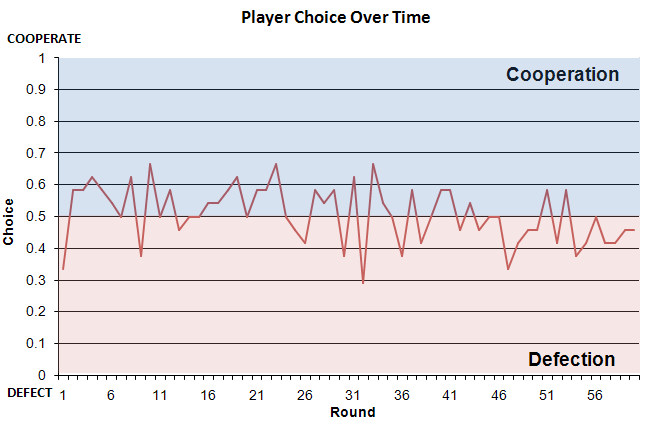
The expected results are a steady trend towards cooperation over time. Instead, the data suggests a trend for players to defect against one another over time.
Naturally this is troublesome - it implies the project failed in its most important goal. However, during the testing phase a variable cropped up that hadn't been accounted for: phrasing of the win condition.
At first, players were prompted to get a higher score than their partner. This caused an extreme shift towards competitive strategies for the first several pairs of players. After I realized what had happened, I prompted the players to get the highest score possible. While this was closer to the win condition of IPD, it was not perfect: players had no score to compare against. These players adjusted to a mixed cooperation-defection similar to the graph above. The final set of players were told to beat the high score and were given a number on a piece of paper to compare against. This was the correct win condition.
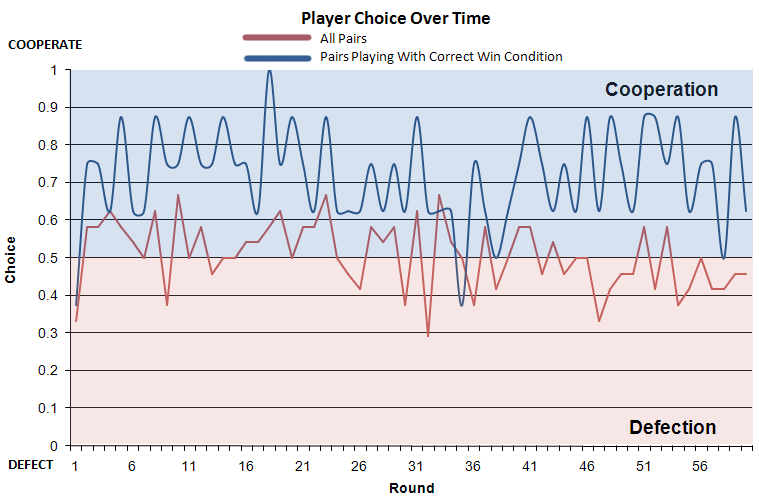
The red line shows the average of all choices players made throughout the game. The blue line only looks at players that used the correct win condition - beat the high score. (The smaller sample size accounts for the greater variation in the data).
While the overall data shows a slight tendency towards defection, the correct play test group continues to have a high rate of cooperation throughout the game. While it's not a slope (highly possible because of the small sample size), it does show that players still react predictably in an iterated Prisoner's Dilemma, favoring cooperation over defection in the long run.
Food for Thought
Of all the data taken and analyzed, one piece presents an interesting correlation between score and the choice players made.
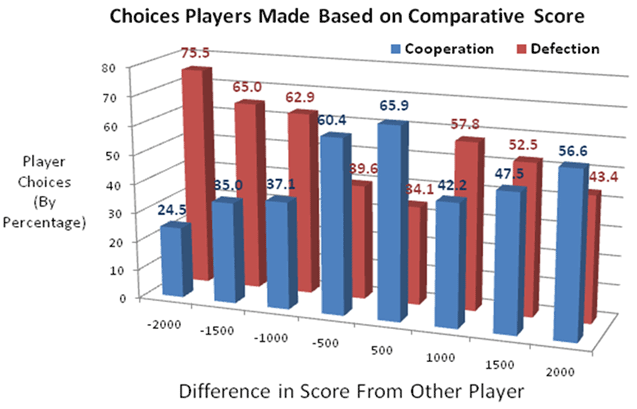
This is correlation, not causation, so there's two possible interpretations:
- If players are losing by a landslide, they are far more likely to betray the other player
- If players betray the other player, they are far more likely to fall behind in score
Note that if a player is winning it's a pretty even chance he'll choose to cooperate or defect, and if the player scores are within 500 points of each other they are also more likely to cooperate.
Conclusion
The Gamer's Dilemma is a mixed success. There were two things this project attempted to do:
- Implement the Iterated Prisoner's Dilemma in a video game where players move from betraying one another to cooperating with one another
- Make the Iterated Prisoner's Dilemma fun
Once the data came out, it seems that instead of an emergent cooperative gameplay there was an emergent defective gameplay. However, variables strongly influenced the outcomes and the variable identified as the most influential was actually how the win condition was phrased. Players drastically changed their strategies based on what they perceived as their goal. IPD, though, has a very specific goal in mind - get the highest possible score - and once play testers played with this goal in mind their choices turned out to highly favor cooperation. There was no trend to go from defection to cooperation, but that can be due to other variables (such as the stronger positive feedback from choosing to bomb - cooperate - than store energy - or defect).
On the second, feedback from players showed the game to be fun and the Prisoner's Dilemma gameplay mechanic to be very interesting. It lacks some of the polish one would typically expect of a game (such as a tutorial, high scores tables, and formal end game), but despite this players largely enjoyed the game.
There are many other variables that influenced player choices and caveats about the project - everything from the control scheme to the implementation of a timer or number of enemies on the screen at a time. These are outlined in the actual thesis paper along with other data and research. However, these pages do a good job summarizing and explaining the most important parts of this Master's project.
More Information
You can download the full text of my Master's project, which spends much more time going in depth to some of the issues with cooperation in games, the full effect of the Prisoner's Dilemma and Iterated Prisoner's Dilemma, and a full breakdown of all the results and variables that affected the final outcome.
For external resources, I suggest the book "Evolution of Cooperation" by Axelrod, which is a full account of the first major IPD tournament and what its findings actually mean for other fields.
I'd be happy to discuss the project with anyone interested. Contact me at lizengland07[at]gmail.com